A day after having first seen it, I'm still kind of traumatized by Fritz the Cat. Being the first X-rated animated feature carries with it certain expectations, which were more than met. But there's a whole lot more going on besides sex and general raunchiness. There's a gleeful irreverence toward hippies, some shall we say, frank racial content, and violence that's way more discomfiting than the genitalia whipped about. There's real wit behind the proceedings, particularly the opening scene with some college girls' clueless condescension to a black man they're fawning over ("Why does a great actor like James Earl Jones always have to play black men?"), followed by Fritz's wooing them by pretending to be a tortured soul. There's also something approaching affection in a scene in a synagogue, particularly when one of the cops (a pig!) complains that goyim aren't supposed to sing, that could only come from intimate familiarity (the Fritz the Cat comic's creator, Robert Crumb, recently published a comic version of the Book of Genesis, all 50 chapters).
In spite of this, though, the whole thing has a nasty edge to it that I can't entirely articulate in words; I think pointing to the scene of the Nazi cult biker tying his girlfriend to the bed naked and whipping her with a chain, is illustrative. Or when Fritz starts a race riot that leads to Harlem being bombed by fighter jets. The wit at work is very pointed, indeed, and spares no one, including the viewer.
The net effect of it all is kind of a hectic jumble. That makes it hard to think of Fritz the Cat as a "good" movie, but then again that kind of distinction is kind of beside the point. It's an underground movie based on an underground comic book that isn't looking for mainstream acceptance, so you almost have to approach it on its own terms. Its merciless nature also gives me the sense that it probably isn't a terribly great exaggeration of what the 60s were actually like. That it's still so shocking to a viewer as jaded as myself 38 years on is saying something.
Friday, August 20, 2010


Hitchens' Timing
The timing of Christopher Hitchens’ esophageal cancer is quite striking. Having only received Hitch-22 in the mail a few days ago and being already committed to Midnight’s Children, I’ve only read the memoir’s “Prologue With Premonitions.” Yet just this introduction, which I read as Hitchens undergoes chemotherapy, takes the breath away. Framed around a National Portrait Gallery brochure’s typo describing him as “the late Christopher Hitchens,” its meditations on impending death seem to presage the cancer that brought an end to the subsequent book tour. These sentences in particular gain in urgency:
For Hitchens, “too late” would have been a matter of months, not years. I am sure he would dispute the notion of his cancer’s timing being providential, so instead let us be happy for his prudence.
When I first formed the idea of writing some memoirs, I had the customary reservations about the whole conception being perhaps “too soon.” Nothing dissolves this fusion of false modesty and natural reticence more swiftly than the blunt realization that the project could become, at any moment, ruled out of the question as having been undertaken too “late.”
For Hitchens, “too late” would have been a matter of months, not years. I am sure he would dispute the notion of his cancer’s timing being providential, so instead let us be happy for his prudence.
Monday, August 2, 2010
How Things Change
Iraq's electrical grid is failing and the people are none too happy:
So much for democracy, whiskey, sexy.
“Democracy didn’t bring us anything,” Mr. Farhan said in his newly darkened shop. Then he corrected himself. “Democracy brought us a can of Coke and a beer.”
So much for democracy, whiskey, sexy.
Wednesday, July 21, 2010
The Inmates are Running the Asylum
So let me get this straight:
- Andrew Breitbart releases video of Shirley Sherrod saying she didn't want to help white farmers
- Fox News spreads the video hither and yon
- NAACP condemns Sherrod
- Tom Vilsack (vil)sacks Sherrod
- NAACP gets ahold of the full video--in which Sherrod's not wanting to help the white farmers is preceded by the story of her father being murdered with impunity by a white man, and followed by seeing the white farmers get screwed by the white lawyer she recommended and learning that it's not about white vs. black but rich vs. poor--and apologizes for being "snookered"
- Vilsack stands by his decision
- White House stands by Vilsack
- Fox News, by way of Glenn Beck, attacks the White House for firing Sherrod
Remember those boisterous town hall gatherings last summer? Those were nice, weren't they? I imagine we'll be looking on this episode equally fondly this time next year, when the Republicans have gained seats in the House and the Senate, and Breitbart and his horde have trashed the careers and organizations of countless others in the meantime.
It's not like Obama's going to stick up for them.
- Andrew Breitbart releases video of Shirley Sherrod saying she didn't want to help white farmers
- Fox News spreads the video hither and yon
- NAACP condemns Sherrod
- Tom Vilsack (vil)sacks Sherrod
- NAACP gets ahold of the full video--in which Sherrod's not wanting to help the white farmers is preceded by the story of her father being murdered with impunity by a white man, and followed by seeing the white farmers get screwed by the white lawyer she recommended and learning that it's not about white vs. black but rich vs. poor--and apologizes for being "snookered"
- Vilsack stands by his decision
- White House stands by Vilsack
- Fox News, by way of Glenn Beck, attacks the White House for firing Sherrod
Remember those boisterous town hall gatherings last summer? Those were nice, weren't they? I imagine we'll be looking on this episode equally fondly this time next year, when the Republicans have gained seats in the House and the Senate, and Breitbart and his horde have trashed the careers and organizations of countless others in the meantime.
It's not like Obama's going to stick up for them.
Sunday, July 18, 2010
Mock Their Stylin'
This website claims to analyze your writing style based on whatever samples you provide. Eric Martin of Obsidian Wings, for instance, seems to have absorbed David Foster Wallace's technique without having ever read him. I plugged in some of the most recent posts of this blog, and the results were thus:
- Where the Wild Things Are review: Stephen King
- Notes From Underground Analysis: Leo Tolstoy
- Shutter Island review: Chuck Palahniuk
- Wisdom teeth removal: Charles Dickens
- Finding Nemo review: David Foster Wallace
Based on these results it seems the algorithm is based more on name associations than style. Tolstoy was, of course, a contemporary of Dostoyevsky, and Fight Club and Tyler Durden are explicitly mentioned in the Shutter Island review. This, and the fact that the list of authors includes almost exclusively white males brings its worth down from mere timewaster to waste of timewaster. Lame.
UPDATE: Worse than waste of waste of time, the website is actually something of a scam for a vanity publisher.
- Where the Wild Things Are review: Stephen King
- Notes From Underground Analysis: Leo Tolstoy
- Shutter Island review: Chuck Palahniuk
- Wisdom teeth removal: Charles Dickens
- Finding Nemo review: David Foster Wallace
Based on these results it seems the algorithm is based more on name associations than style. Tolstoy was, of course, a contemporary of Dostoyevsky, and Fight Club and Tyler Durden are explicitly mentioned in the Shutter Island review. This, and the fact that the list of authors includes almost exclusively white males brings its worth down from mere timewaster to waste of timewaster. Lame.
UPDATE: Worse than waste of waste of time, the website is actually something of a scam for a vanity publisher.
Saturday, July 17, 2010
Deep Blue Sea
I missed the boat when this originally came out, but Finding Nemo deserves praise even seven years after release. Marlin teaches Nemo early on that “The ocean is dangerous,” and he isn’t kidding. I don’t think I’ve ever gasped in that “Omigodthey’reinsomuchTROUBLE!” way so many times in one sitting since I was, well, a kid. Besides the tremendous effort that went into making sure every element in the film works exactly as intended, I think a big reason for all that open-mouthed suspense is the movie’s first scene, which would be traumatic even in an “adult” film, and is downright shocking in a kids’ flick. But damn if it doesn’t put the stakes right up front. Louis Fantasia defines drama as “expectation mixed with uncertainty,” and Pixar have consistently proven themselves the celluloid champions thereof. I just wish I had gotten over my moody/rebellious/edgy teenage ‘I’m too old for this stuff’ attitude when most of their previous movies were still in theaters. Luckily, Toy Story 3 is still making the rounds, and I may be able to continue my penance yet.
Wednesday, July 14, 2010
Shutter Island
I had an inkling before I saw Shutter Island of what The Twist was going to be, and hoped I was going to be wrong, the better to be surprised. I ended up being right, and though it's not as damaging to the rest of the movie as it could be, it doesn't do it any favors, and that's still a problem.
I very much enjoyed the ride up until the point that it pulls the rug out, at which point everything basically started over from square one. That's not true in, say, Fight Club; Edward Norton's Narrator actually being Tyler Durden doesn't in any way negate the development their relationship has undergone. It's one more complication that sends the third act towards a conclusion (Tyler vs. The Narrator) that's literally been building since the beginning of the movie.
Rather than enhancing the themes and conflicts that we've been watching unfold for the last two hours, Shutter Island's Big Twist throws them completely out. To its credit it takes a good twenty minutes to try to square this new circle, and the performers are all game, but it doesn't change the fact that an entirely new story arc is beginning and ending in less than a half hour, mostly as an apology for having essentially wasted our time.
'Wasted our time' doesn't exactly do justice to what I'm trying to say, because I actually did say I liked everything before the switch. It's not time wasted, but cheated; the movie is cheating on its audience, and coming from a broken home, I don't take kindly to infidelity.
I very much enjoyed the ride up until the point that it pulls the rug out, at which point everything basically started over from square one. That's not true in, say, Fight Club; Edward Norton's Narrator actually being Tyler Durden doesn't in any way negate the development their relationship has undergone. It's one more complication that sends the third act towards a conclusion (Tyler vs. The Narrator) that's literally been building since the beginning of the movie.
Rather than enhancing the themes and conflicts that we've been watching unfold for the last two hours, Shutter Island's Big Twist throws them completely out. To its credit it takes a good twenty minutes to try to square this new circle, and the performers are all game, but it doesn't change the fact that an entirely new story arc is beginning and ending in less than a half hour, mostly as an apology for having essentially wasted our time.
'Wasted our time' doesn't exactly do justice to what I'm trying to say, because I actually did say I liked everything before the switch. It's not time wasted, but cheated; the movie is cheating on its audience, and coming from a broken home, I don't take kindly to infidelity.
Monday, July 5, 2010
Wild Things
It's been over a month since I've written anything, mostly on account of being incredibly busy. Seven Devils happened, work picked up so that I'm now actually working full-time, and I've started rehearsals for David Mamet's Oleanna. My internet time has receded accordingly. I'll do what I can is all I can promise, and even that's uncertain.
I thought I would just say for my return post that I found Spike Jonze's Where the Wild Things Are to be....distancing? Cold? Off-putting? I don't know what it is--and this is why I'm not a film reviewer--but something doesn't feel right throughout the proceedings. Maybe it's the way the documentary-style shakeycam clashes with the fantastical nature of the story. Maybe it's the way the fantastic wild things likewise behave like grown up children. Maybe it's the score (which I would like to blame more on Karen O than Carter Burwell) that's constantly intruding on the action rather than complementing it. I don't know.
I read somewhere else that WTWTA is not a kids movie, it's a movie about being a kid, for grown-ups, and that sounds about right.
I thought I would just say for my return post that I found Spike Jonze's Where the Wild Things Are to be....distancing? Cold? Off-putting? I don't know what it is--and this is why I'm not a film reviewer--but something doesn't feel right throughout the proceedings. Maybe it's the way the documentary-style shakeycam clashes with the fantastical nature of the story. Maybe it's the way the fantastic wild things likewise behave like grown up children. Maybe it's the score (which I would like to blame more on Karen O than Carter Burwell) that's constantly intruding on the action rather than complementing it. I don't know.
I read somewhere else that WTWTA is not a kids movie, it's a movie about being a kid, for grown-ups, and that sounds about right.
Sunday, May 30, 2010
Notes on Notes From Underground
Credit where credit’s due: the idea of seeking out Notes From Underground was first seeded by Matt Yglesias’ list of influential books from a few months back. Had I not read that, I might not have picked it up at a used book sale, or at least been compelled to read it so soon. He calls the first section of the first half “the greatest stretch of prose in human history,” but the rest is hardly slack. As polemical writing goes, it’s some of the best one could come across in any language, of any persuasion. Take this passage from Chapter IX:
What prose! The mingling of abstraction and concrete imagery! The immediate, sneering tone! And is it too much to think ‘twice-two-makes-five’ as a form of individual revolt, was the basis of Orwell’s reworking of that formulation as a summation of totalitarian’s absolute mastery over the individual? The delight that swaths of our current population takes in this sort of brute counterfactualism ("Keep the government out of my Medicare!") need hardly be mentioned. Nihilism scarce had a better apologist than the Underground Man of the Notes' first section.
The second half is less effective, though I would like to think this is by design. For the first half is entirely theoretical and, on its own terms, quite effective; we may not like the Underground Man, but damn if we don’t respect his crude integrity. The second half puts this philosophy of ultra-pessimism into action in several case studies—a desire to get an officer’s attention, a sadomasochistic imposition on his schoolmates’ dinner, the emotional manipulation of a beautiful young prostitute—and all of them find the Underground Man to be increasingly repulsive and, more important, impotent. The caustic wit of the first half is almost comically helpless against his irrational compulsion to debase himself before people whom he holds in the highest contempt, who couldn’t care less about him anyway. What before seemed a compelling if distasteful stance against faith in progress is revealed to be an ineffectual and embarrassing revel in one’s own misery.
Misery was key to Dostoyevsky’s outlook, of course. His later novels (Crime and Punishment is the only other I have read) go on to develop the notion of man’s bestial nature and its only hope lying in divine salvation. What is striking about Notes is the almost complete absence of this notion of penance. The Underground Man expounds on it at length in his discourse with the prostitute Liza, and it is on these precepts that she ostensibly begins to turn her life around. But the Underground Man repudiates everything he’s told her as soon as he has said so, and his failure to go after her in the end is painted as a grotesque redemption of sorts:
The Dostoyevsky of later years would seem to elect the former—-after having stewed plentifully in the latter, to be sure. Following several days of guilt-fueled delirium, Crime and Punishment’s Raskolnikov finds solace in another woman, Sonya Marmeladova, and the two of them await their reunion that will follow when his sentence in Siberia has been served. Dostoyevsky was all about redemption through suffering, but in this work, at the beginning of his mature period, the only reason one seems to stand any chance of improvement and moral regeneration is by rejecting false saviors, and even that’s hardly a guarantee. It’s all suffering and no redemption.
That is why I find it hard to believe the Underground Man’s stance is meant to be taken at face value. The especially acid outlook on human existence he conveys has been thought to be a function of Dostoyevsky’s personal distresses at the time of its writing, but it could also be he intended we be seduced by the Underground Man’s anti-philosophy, in order to more acutely understand the dead ends—the inherent stagnation—it leads to when practically applied. I suspect a mixture of the two, that at that point in his life Dostoyevsky felt this pessimism quite intensely but also knew that, taken to its logical conclusion, it could only terminate in bootless misanthropy, that there must be a better solution to the problem of man’s baseness.
On those grounds, I think Yglesias’ description of Notes From Underground as “an illustration of the power of great writing to convey radically unsound or even totally nonsensical ideas” doesn’t give the author quite enough credit. But then again, Dostoyevsky was a very damaged individual; perhaps he meant it all, and, fittingly, I am not giving enough credence to the man’s irrationality.
*Sartre considered Notes a seminal text in Existentialism, so it is not at all surprising to see in this line a precursor to Hamm's "Can there be misery loftier than mine?" in Beckett's Endgame.
Yes, man is a comical animal, and there’s obviously a joke in all this. Still, I say that twice two [makes four] is an unbearable notion, an arrogant imposition. This twice two image stands there, hands in pockets, in the middle of your road, and spits in your direction. Nevertheless, I’m willing to agree that twice-two-makes-four is a thing of beauty. But, If we’re going to praise everything like that, then I say that twice-two-makes-five is also a delightful little item now and then.
What prose! The mingling of abstraction and concrete imagery! The immediate, sneering tone! And is it too much to think ‘twice-two-makes-five’ as a form of individual revolt, was the basis of Orwell’s reworking of that formulation as a summation of totalitarian’s absolute mastery over the individual? The delight that swaths of our current population takes in this sort of brute counterfactualism ("Keep the government out of my Medicare!") need hardly be mentioned. Nihilism scarce had a better apologist than the Underground Man of the Notes' first section.
The second half is less effective, though I would like to think this is by design. For the first half is entirely theoretical and, on its own terms, quite effective; we may not like the Underground Man, but damn if we don’t respect his crude integrity. The second half puts this philosophy of ultra-pessimism into action in several case studies—a desire to get an officer’s attention, a sadomasochistic imposition on his schoolmates’ dinner, the emotional manipulation of a beautiful young prostitute—and all of them find the Underground Man to be increasingly repulsive and, more important, impotent. The caustic wit of the first half is almost comically helpless against his irrational compulsion to debase himself before people whom he holds in the highest contempt, who couldn’t care less about him anyway. What before seemed a compelling if distasteful stance against faith in progress is revealed to be an ineffectual and embarrassing revel in one’s own misery.
Misery was key to Dostoyevsky’s outlook, of course. His later novels (Crime and Punishment is the only other I have read) go on to develop the notion of man’s bestial nature and its only hope lying in divine salvation. What is striking about Notes is the almost complete absence of this notion of penance. The Underground Man expounds on it at length in his discourse with the prostitute Liza, and it is on these precepts that she ostensibly begins to turn her life around. But the Underground Man repudiates everything he’s told her as soon as he has said so, and his failure to go after her in the end is painted as a grotesque redemption of sorts:
“And isn’t it much better,” I mused later, back at home, trying to soothe the living pain with my fantasies, “for her to bear this humiliation as long as she lives, because humiliation is purification, because it causes the most corrosive, the most painful awareness? I’d have soiled her soul and tired her heart no later than tomorrow, but this insult and humiliation will never be extinguished in her; whatever filth surrounds her, my insult will elevate her, purify her through… through hatred… well… maybe through forgiveness…. But will it really be easier for her now?”
No. But let me ask a question now on my own behalf: what’s better—cheap happiness or lofty suffering?* Well, tell me—which of the two is better?
The Dostoyevsky of later years would seem to elect the former—-after having stewed plentifully in the latter, to be sure. Following several days of guilt-fueled delirium, Crime and Punishment’s Raskolnikov finds solace in another woman, Sonya Marmeladova, and the two of them await their reunion that will follow when his sentence in Siberia has been served. Dostoyevsky was all about redemption through suffering, but in this work, at the beginning of his mature period, the only reason one seems to stand any chance of improvement and moral regeneration is by rejecting false saviors, and even that’s hardly a guarantee. It’s all suffering and no redemption.
That is why I find it hard to believe the Underground Man’s stance is meant to be taken at face value. The especially acid outlook on human existence he conveys has been thought to be a function of Dostoyevsky’s personal distresses at the time of its writing, but it could also be he intended we be seduced by the Underground Man’s anti-philosophy, in order to more acutely understand the dead ends—the inherent stagnation—it leads to when practically applied. I suspect a mixture of the two, that at that point in his life Dostoyevsky felt this pessimism quite intensely but also knew that, taken to its logical conclusion, it could only terminate in bootless misanthropy, that there must be a better solution to the problem of man’s baseness.
On those grounds, I think Yglesias’ description of Notes From Underground as “an illustration of the power of great writing to convey radically unsound or even totally nonsensical ideas” doesn’t give the author quite enough credit. But then again, Dostoyevsky was a very damaged individual; perhaps he meant it all, and, fittingly, I am not giving enough credence to the man’s irrationality.
*Sartre considered Notes a seminal text in Existentialism, so it is not at all surprising to see in this line a precursor to Hamm's "Can there be misery loftier than mine?" in Beckett's Endgame.
Wednesday, May 26, 2010
Stupid Wisdom Teeth
I just had two wisdom teeth extracted. I thought it would be three (I had my upper left pulled a few years ago), but my upper right wisdom just never came in, which I find a little disconcerting given the symmetry our DNA is supposed to code for. Intelligent Design indeed. I'm biting down on a gauze strip now, my lower jaw still numb, and so verbal communication is impaired, though not entirely impossible. This, writing, is much preferable, however. It makes one appreciate lucid thinking all the more.
The injection into my jaw gave me some initial pain in my ear, apparently because the nerve loops around there. When I started to go numb I began to feel an itching on my chin that no amount of scratching, short of maybe ripping off my skin, could satisfy. I needed another shot because of some extra sensitivity in the back of my jaw. This we found out by my groans when the dentist pressured and jiggled my teeth.
We had started on the left wisdom, but it proved troublesome and so the dentist "gave me a break" by working on the right. It was a straightforward affair, as far as these things go. It neither took very long, nor provided any memorable complications. The left, however, continued to be an incorrigible sonofabitch. The dentist, having loosed the tooth from its gummy moorings, attempted to pull it out in the normal fashion. It refused cooperation, however. The dentist brought up the possibility of surgical removal, but only to say he wanted to avoid doing that. Instead he got out the drill, in order to score it and split it and remove the pieces.
The experience of all this was not brutally painful, not all the time anyway, but for one who's lived as sheltered a life as I, it was probably the most pain I've ever been in, and it was enough to make me reflect on how cruel Dr. Mengele really was. Additionally, much of my anguish was not physical, but psychological: every crack and pop, scrape and grind I heard not only externally--a sound wave vibration that entered my ears--but also reverberating inside my head, prompting me to wince and yelp with every unpleasant development, regardless of the actual pain it was causing.
"This will give you something to write about," the dentist said during the procedure. I grunted assent. "You know, I saw Little Shop of Horrors before it went to Broadway, way back in the day."
After a particularly loud crack I babbled, "I' ih ovah?" It wasn't. That had only been the crown. The rest of it was soon to follow, and on its removal the issue was apparent: the root of the tooth was curved, and had been hooking into my jaw whenever it was being pulled out. After biting down on some gauze pads I was good to go.
My lower jaw will be numb for at least a couple more hours. In the meantime my lip feels fat, my swallowing is weak and cautious (don't want to upset those blood clots). I open and close my mouth periodically, like a fish. I feel old. Pressing around my ear, where numbness and feeling mingle, produces an odd, unwanted, sensation. My stomach feels just the slightest bit queasy, perhaps because of swallowing some blood, perhaps because I let myself be way too sensitive to these things.
I have a few days off from work, during which I'm going to take the downtime to watch Apocalypse Now and Dolomite, continue reading Dostoyevsky's Notes From Underground, and write, if I can focus. Maybe play some video games, which I seem to have little time for these days. When I had my first wisdom tooth pulled I watched the Lord of the Rings trilogy extended edition in its entirety, back to back, while working out the entire arc of a cartoon I was doing for my school newspaper. This is a good occasion for large undertakings.
The injection into my jaw gave me some initial pain in my ear, apparently because the nerve loops around there. When I started to go numb I began to feel an itching on my chin that no amount of scratching, short of maybe ripping off my skin, could satisfy. I needed another shot because of some extra sensitivity in the back of my jaw. This we found out by my groans when the dentist pressured and jiggled my teeth.
We had started on the left wisdom, but it proved troublesome and so the dentist "gave me a break" by working on the right. It was a straightforward affair, as far as these things go. It neither took very long, nor provided any memorable complications. The left, however, continued to be an incorrigible sonofabitch. The dentist, having loosed the tooth from its gummy moorings, attempted to pull it out in the normal fashion. It refused cooperation, however. The dentist brought up the possibility of surgical removal, but only to say he wanted to avoid doing that. Instead he got out the drill, in order to score it and split it and remove the pieces.
The experience of all this was not brutally painful, not all the time anyway, but for one who's lived as sheltered a life as I, it was probably the most pain I've ever been in, and it was enough to make me reflect on how cruel Dr. Mengele really was. Additionally, much of my anguish was not physical, but psychological: every crack and pop, scrape and grind I heard not only externally--a sound wave vibration that entered my ears--but also reverberating inside my head, prompting me to wince and yelp with every unpleasant development, regardless of the actual pain it was causing.
"This will give you something to write about," the dentist said during the procedure. I grunted assent. "You know, I saw Little Shop of Horrors before it went to Broadway, way back in the day."
After a particularly loud crack I babbled, "I' ih ovah?" It wasn't. That had only been the crown. The rest of it was soon to follow, and on its removal the issue was apparent: the root of the tooth was curved, and had been hooking into my jaw whenever it was being pulled out. After biting down on some gauze pads I was good to go.
My lower jaw will be numb for at least a couple more hours. In the meantime my lip feels fat, my swallowing is weak and cautious (don't want to upset those blood clots). I open and close my mouth periodically, like a fish. I feel old. Pressing around my ear, where numbness and feeling mingle, produces an odd, unwanted, sensation. My stomach feels just the slightest bit queasy, perhaps because of swallowing some blood, perhaps because I let myself be way too sensitive to these things.
I have a few days off from work, during which I'm going to take the downtime to watch Apocalypse Now and Dolomite, continue reading Dostoyevsky's Notes From Underground, and write, if I can focus. Maybe play some video games, which I seem to have little time for these days. When I had my first wisdom tooth pulled I watched the Lord of the Rings trilogy extended edition in its entirety, back to back, while working out the entire arc of a cartoon I was doing for my school newspaper. This is a good occasion for large undertakings.
Sunday, May 23, 2010
Shepard Fairey Post-Script
This review of one of Shepard Fairey's exhibitions in 2009 says many of the things I do, and better, and with more knowledge at its disposal:
His bottom line:
To this day, he insists that his oeuvre expresses no ideology, that its cardinal message is simply "question everything." Aside from being a lowest-common-denominator philosophy, this is doing a disservice to the urgency of his work’s better messages -- his environmentalism, his anti-war views, etc. Presumably, Fairey actually wants to move people with these works. At the same time, the dictum’s vague character reflects Fairey’s own political vagueness
His bottom line:
Still, at the end of the day, it is Fairey’s aura of idealism -- that his art actually gets out of the gallery and does stuff, that it speaks a popular language, that it feels righteous and relevant -- that has given this show such tremendous resonance. And if there is one thing that his success shows, it’s that images and ideas can take on a life all of their own, and transcend their source. In the political realm, the Obama campaign has inspired hopes, demands and even activism that go far beyond President Obama’s policy prescriptions, which are, after all, pretty limited. If Fairey’s success has something of this effect for the art world, that’s a good thing.
Shepard and Sheep

I don't know what to make of Shepard Fairey. He's "made it," there's no doubt about that. He's affected American culture not once but twice, first in those ubiquitous Andre the Giant 'OBEY' stickers in the late 80s (which dotted the levels of a Tony Hawk video game not too long ago), and more recently, of course, with the Barack Obama 'HOPE' portrait that defined the 2008 presidential election and went on to become the basis of a Facebook app. That latter portrait now hangs in the National Gallery. Whatever else he may do, Fairey's place in history is secure. In today's fractured, internet-driven culture, that is tremendous.
But what of the work itself? For the Obama picture, memorable though it was, is well in keeping with Fairey's style: a bold, stenciled image of a famous person made with two or three complementary colors over a newspaper college backdrop, with an occasional message (often 'OBEY'). Take the grandeur of Soviet Realism...

...Warholian distancing...

...and street art minimalism;

...mix them together and you've got a reasonable summation of the Shepard Fairey style.
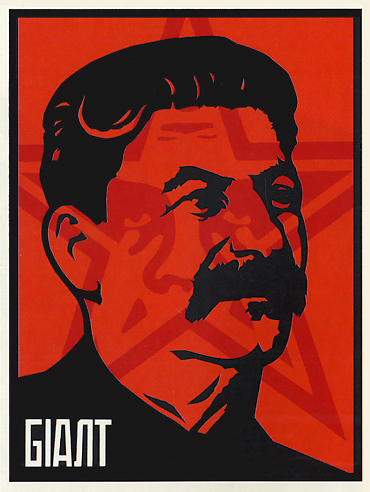
The result, much like 'HOPE,'is visually arresting and usually has something to say. These are both virtues. The problem, with, say, the Young British Artists like Damien Hirst and Tracey Emin is that quite often their work is ugly and pointless and is only art because they say it is. Fairey's very good at what he does, and he's not out to scam millionaires and art snobs, and for that we can be glad.
What vexes me is the contradiction that runs through this style. The art very consciously appropriates the grandiloquent kitschiness of communist propaganda and takes the piss out of it, but instead of being a joke on its subject, like the 2005 Stalin piece above, or a joke in itself, like his Andre the Giant, it often goes on to make a sincere political statement, or at least imply one. Irony and earnestness thus mingle uncomfortably, even in the portraits without big words.
It's self-defeating. Andy Warhol always denied any deeper meaning to his work ("There's nothing behind it."); the superficiality, the product of a then-new mass-produced culture, was exactly the point. What to make of the obvious affection (note the dove and 'WAR IS OVER!' clippings) Fairey has for the Dalai Lama or John and Yoko when they are depicted in a style already acknowledged to be, and mocked for being, propagandistic?


Perhaps predictably, Fairey is more successful when he breaks from this formula (I hate to call it that, but what else could facilitate such prodigious output?). The first, smaller, room of the Deitch Projects MayDay exhibit that I caught during my New York trip--which coincided with Free Gallery Week--features three pieces that are not portraits, and, while perhaps not as handsome, are more successful in their efforts. The first (unfortunately I did not get the titles) is a conscious quote of Jasper Johns' (whose portrait is a part of the exhibit) Flag, which was also painted over newsprint collage.


The second reads, "Check Your Oil|America's Favorite|Flammable Liquid."

The third, near as I can tell, is just a surfer catching a wave. Note the unusual blue color scheme.

Divorced from a style that is the basis an expensive novelty gift, their intent--and occasional message--come through far more successfully. This is also in part due to the fact that they stand apart. The MayDay exhibit consists only of work produced in 2010, most of it of the portrait variety, and there is so much that it becomes exhausting. As I said, Shepard Fairey is very good at what he does, but its effect is diminished when it is done so often. I should hope that his (further) raised profile will push him into new directions. I'm certainly interested in him enough to find out more and watch his development.
Friday, May 21, 2010
Everybody Draw Mohammad Day
I'm posting this late, but why confine blasphemy to a single day?

This criticism of Everybody Draw Mohammad Day is valid as far as it goes, which is to say, college campuses. Going out of one's way to be obnoxious towards particular fellow students is, well, obnoxious (I did it to a Mormon teacher in high school, and yeah, I'll admit I was a dick). There's nothing to be gained in such a localized setting.
The real target is global, which is why this broader critique misses the point. To recap:
- South Park once inserted Mohammad into the show, in the Super Best Friends episode, without incident in pre-9/11 2001.
- When they attempted a Mohammad appearance so as part of an episode about the Danish cartoon controversy, Comedy Central refused to show the scene.
- When they recently made fun of Mohammad's non-appearance by having him "appear" in a bear suit, some twats from Revolution Muslim passive-aggressively stated that South Park's creators, Trey Parker and Matt Stone, would suffer the same fate as Theo Van Gogh, who was murdered in broad daylight.
- In response, Comedy Central did not rerun the episode, nor did they stream it online. They also removed Super Best Friends from online view.
Some additional context:
- Many news outlets refused to show the offending Danish cartoons when the story broke in 2005, and several of the editors involved in those that did were fired.
- Ayaan Hirsi Ali, who wrote the script and provided the voice over to Theo Van Gogh's Submission film, was threatened in a note pinned to his body and at one point had to collect donations to cover her security costs.
- Kurt Westergaard, one of the Danish cartoonists, was attacked with an axe in his home while he was taking care of his five year-old granddaughter.
- A Swedish cartoonist, Lars Vilks, who drew a picture of Mohammad's head on a dog's body was head-butted and had his house set on fire, having already been the target in a foiled murder plot.
Everybody Draw Mohammad Day is a response to intimidation and suppression of free speech. If Trey Parker and Matt Stone are to be threatened with death for depicting the prophet, the theory goes, then so will the rest of us. It's a debased version of the Danes all wearing Stars of David to protect their Jews from the Nazis, except that--given the different circumstances--this time the participants mock a religious icon rather than honor it (also, this event has the benefit of having now actually happened).
I admit this is bullshit symbolism with no practical benefit in itself--which I usually hate--but putting this on the internet for all to see, potentially, if remotely so, puts its participants at risk. Any violence to occur as a result of it would make the point all the more obvious and strengthen the cause, which is more than can be said for the usual plant-a-flag-for-Darfur crap.
Ahmed Rehab, the author of the objection to Everybody Draw Mohammad Day, complains about a campaign that would willingly offend Muslims, which this no doubt does. My only response is a question: which is more offensive: this?

Or this?


This criticism of Everybody Draw Mohammad Day is valid as far as it goes, which is to say, college campuses. Going out of one's way to be obnoxious towards particular fellow students is, well, obnoxious (I did it to a Mormon teacher in high school, and yeah, I'll admit I was a dick). There's nothing to be gained in such a localized setting.
The real target is global, which is why this broader critique misses the point. To recap:
- South Park once inserted Mohammad into the show, in the Super Best Friends episode, without incident in pre-9/11 2001.
- When they attempted a Mohammad appearance so as part of an episode about the Danish cartoon controversy, Comedy Central refused to show the scene.
- When they recently made fun of Mohammad's non-appearance by having him "appear" in a bear suit, some twats from Revolution Muslim passive-aggressively stated that South Park's creators, Trey Parker and Matt Stone, would suffer the same fate as Theo Van Gogh, who was murdered in broad daylight.
- In response, Comedy Central did not rerun the episode, nor did they stream it online. They also removed Super Best Friends from online view.
Some additional context:
- Many news outlets refused to show the offending Danish cartoons when the story broke in 2005, and several of the editors involved in those that did were fired.
- Ayaan Hirsi Ali, who wrote the script and provided the voice over to Theo Van Gogh's Submission film, was threatened in a note pinned to his body and at one point had to collect donations to cover her security costs.
- Kurt Westergaard, one of the Danish cartoonists, was attacked with an axe in his home while he was taking care of his five year-old granddaughter.
- A Swedish cartoonist, Lars Vilks, who drew a picture of Mohammad's head on a dog's body was head-butted and had his house set on fire, having already been the target in a foiled murder plot.
Everybody Draw Mohammad Day is a response to intimidation and suppression of free speech. If Trey Parker and Matt Stone are to be threatened with death for depicting the prophet, the theory goes, then so will the rest of us. It's a debased version of the Danes all wearing Stars of David to protect their Jews from the Nazis, except that--given the different circumstances--this time the participants mock a religious icon rather than honor it (also, this event has the benefit of having now actually happened).
I admit this is bullshit symbolism with no practical benefit in itself--which I usually hate--but putting this on the internet for all to see, potentially, if remotely so, puts its participants at risk. Any violence to occur as a result of it would make the point all the more obvious and strengthen the cause, which is more than can be said for the usual plant-a-flag-for-Darfur crap.
Ahmed Rehab, the author of the objection to Everybody Draw Mohammad Day, complains about a campaign that would willingly offend Muslims, which this no doubt does. My only response is a question: which is more offensive: this?
Or this?
Monday, May 17, 2010
Picasso at the Met

I'm a relative neophyte to the art world. I grew up wanting to draw comic books and became pretty good at drawing, but the closest thing I've taken to a proper art class lately was the British art component of the prep course I had to take for the London trip I went on through my school. The London trip itself--with trips to the Tates Modern and Britain, the National Gallery, and others--expanded on the introduction I got from the class, and since then it's been a matter of absorbing what I can from the museums I visit and the books I pick up along the way.
So when The New Republic complains about the Picasso exhibit at the Met being unwieldy and unfocused, I don't really have any response. If I was better versed in the Spaniard's body of work, I suppose I would agree. As you can see here, there is a lot of material crammed together.

But given my limited background, I was more than happy to have so much of it there for me to take in. I had a vague idea of Picasso's range, mostly due to the masterworks at MoMa, but I never knew just how many styles the man went through in his life time, as all that schoolchildren are ever told about is Cubism. To the layman, it's not immediately obvious that creator of Pipe Rack and Still Life on a Table, above, had earlier painted The Blind Man's Meal:

or this self-portrait:

and would go on to make something like Las Meninas and Gentlemen in the Sierra

Discovering all this, in roughly chronological order, was a joy, and so I'm going to call this a win for egalitarianism.
Subscribe to:
Posts (Atom)


 Posts
Posts

